The October workday took place in the Hall o'the Heath Farm orchard. Tools provided via Alistair of the Cheshire East Ranger Service. The plan was to cut back the hedges and overgrown grass and brambles to reduce competition for the fruit trees. The crop of apples appears to have been quite good this year.
Showing posts with label Cheshire East Rangers. Show all posts
Sunday, 2 October 2011
Thursday, 26 November 2009
Tree Planting with Haslington Guides
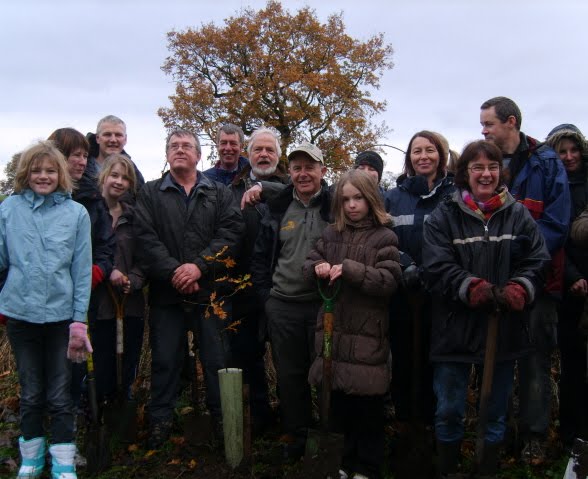
On Sunday 22 November the Haslington Conservation Volunteers were joined by the 1st Haslington Guides and their Senior Section to plant a variety of trees.
During a break in the rain we managed to plant three locally grown oak trees together with a pack of 30 smaller specimens to develop a small copse close to Fowle Brook.
The trees included Hazel, Holly, Dogwood, Hawthorne and Dog rose.
Tree warden Colin Lythgoe identifies the small oak, surrounded by the tree planters. If we come back in a few dozen years it might look like the slightly larger specimen growing on Shukers farm behind the group.
The instructions from Ron required us to remove a small area of grass, two spades by two spades, dig over the ground that was uncovered. Then the tree "plug" was popped into a hole in the loosened soil, firmed in and a stake knocked in alongside - missing the roots. Apparently many bare rooted saplings are killed off by exposing the roots to icy or drying winds, so they need to be kept in the plastic bag until the moment of planting. A tree shelter made from corrugated plastic was then placed over the small tree and tied to the stake. The tree shelter stops attacks by rabbits or other small creatures, but also provides an excellent miniature greenhouse environment to encourage growth. Finally the grass that was dug out is placed face down around the tree - this provides some nutrient but also reduces competition with the tree until its roots are re-established.

Guide Leader Joy Hitchen had obtained the 30 small specimens. The tree shelters were sponsored by the Rotary Club of Haslington. Thanks also to Brian from the Cheshire East Rangers and the parents of the Guides.
During a break in the rain we managed to plant three locally grown oak trees together with a pack of 30 smaller specimens to develop a small copse close to Fowle Brook.
The trees included Hazel, Holly, Dogwood, Hawthorne and Dog rose.Tree warden Colin Lythgoe identifies the small oak, surrounded by the tree planters. If we come back in a few dozen years it might look like the slightly larger specimen growing on Shukers farm behind the group.
The instructions from Ron required us to remove a small area of grass, two spades by two spades, dig over the ground that was uncovered. Then the tree "plug" was popped into a hole in the loosened soil, firmed in and a stake knocked in alongside - missing the roots. Apparently many bare rooted saplings are killed off by exposing the roots to icy or drying winds, so they need to be kept in the plastic bag until the moment of planting. A tree shelter made from corrugated plastic was then placed over the small tree and tied to the stake. The tree shelter stops attacks by rabbits or other small creatures, but also provides an excellent miniature greenhouse environment to encourage growth. Finally the grass that was dug out is placed face down around the tree - this provides some nutrient but also reduces competition with the tree until its roots are re-established.

Guide Leader Joy Hitchen had obtained the 30 small specimens. The tree shelters were sponsored by the Rotary Club of Haslington. Thanks also to Brian from the Cheshire East Rangers and the parents of the Guides.
Friday, 18 September 2009
Mecca
The second location in Macclesfield to be visited by the Haslington Conservation Volunteers was the private woodland of Mr Raymond Maddock. The area known as Mecca, a former equestrian centre contained trees in a variety of settings.
Hornbeam to provide shelter for sheep in a small pit left over from clay extraction. Colin points to a young example of Hornbeam.
Ray had been able to buy many of his thousands of trees from sales at Chelford Market, he became the buyer of last resort where sellers did not want to take their stock home again; this has resulted in a very mixed selection of specimens.
The woodland runs down of reclaimed land towards the Macclesfield canal. This pond full of rushes and reeds is fed from the wood and spills over into the canal.

Hornbeam to provide shelter for sheep in a small pit left over from clay extraction. Colin points to a young example of Hornbeam.Ray discussed the practical aspects of maintaining woodland, cycles of thinning out young trees - which were then used as fuel for his wood burning stove. Having identified the trees to be removed, all the branches up to head height would be removed and the brash cleared away. This would leave the ground clear when the trees were then felled and cut up, if a tree falls in the wrong direction it is quicker and safer if the ground is clear. In areas where the thinning has taken place the undergrowth rapidly moves in again, providing a cycle of habitats within the wood. Small glades have been left within the woodland to provide light and access - a favourite area to see butterflies, or resting members of the HCV.
Ray had been able to buy many of his thousands of trees from sales at Chelford Market, he became the buyer of last resort where sellers did not want to take their stock home again; this has resulted in a very mixed selection of specimens.The woodland runs down of reclaimed land towards the Macclesfield canal. This pond full of rushes and reeds is fed from the wood and spills over into the canal.

Teggs Nose Country Park

The Haslington Conservation Volunteers 2009 educational visits took us to two locations near Macclesfield. The first was to Teggs Nose Country Park to look at the variety of trees around the reservoir.

The old Hornbeam with its twisted trunk and branches may be made up from more than one tree. In times past owners sometimes planted more than one tree in the same hole to act as boundary markers for their land.
Subscribe to:
Posts (Atom)